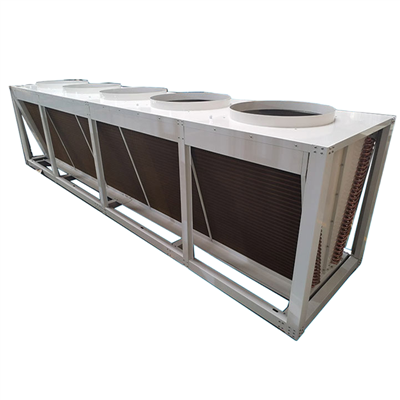
As a supplier of air-cooled condensers, I’ve witnessed firsthand the critical role that the condenser’s surface area plays in its performance. In the world of thermal management, understanding this relationship is not just a matter of technical knowledge; it’s the key to delivering efficient, reliable, and cost – effective solutions to our customers. Air Cooled Condenser
The Basics of Condenser Function
Before delving into the relationship between surface area and performance, let’s briefly recap how an air – cooled condenser works. An air – cooled condenser is a heat exchanger that transfers heat from a hot refrigerant gas to the surrounding air. The refrigerant enters the condenser as a high – pressure, high – temperature gas. As it flows through the condenser tubes, heat is dissipated to the outside air, causing the refrigerant to condense into a liquid state.
This process is fundamental in various cooling systems, including air conditioning units, refrigeration systems, and power plants. The overall efficiency of these systems depends largely on the performance of the condenser.
Surface Area: The Heat Transfer Catalyst
The surface area of a condenser is a primary factor that influences its heat transfer capabilities. In essence, the larger the surface area available for heat exchange, the more efficiently the condenser can transfer heat from the refrigerant to the air. This is because heat transfer occurs at the interface between the refrigerant and the surrounding air.
Mathematically, the rate of heat transfer (Q) in a condenser can be expressed by Newton’s law of cooling: (Q = hA\Delta T), where (h) is the heat transfer coefficient, (A) is the surface area, and (\Delta T) is the temperature difference between the refrigerant and the surrounding air. From this equation, it’s clear that the surface area ((A)) has a direct proportional relationship with the rate of heat transfer.
Impact of Surface Area on Condensing Capacity
The condensing capacity of a condenser refers to its ability to convert the refrigerant from a gaseous state to a liquid state within a given time frame. A larger surface area increases the contact area between the refrigerant and the air, allowing more refrigerant molecules to release their latent heat and condense.
In practical terms, this means that condensers with larger surface areas can handle higher refrigerant flow rates and achieve a lower condensing temperature. A lower condensing temperature is beneficial as it reduces the work required by the compressor in the cooling system, leading to energy savings and improved system efficiency.
For example, in a large – scale industrial refrigeration system, a condenser with an insufficient surface area may struggle to keep up with the heat load. This can result in high condensing pressures, increased compressor power consumption, and ultimately, reduced system performance. On the other hand, a condenser with an optimally designed large surface area can maintain stable operating conditions, ensuring efficient cooling and cost – effective operation.
Airflow and Surface Area Interaction
While surface area is crucial for heat transfer, it doesn’t work in isolation. The interaction between the surface area and airflow is equally important. Adequate airflow is necessary to carry away the heat that is transferred from the refrigerant to the condenser surface.
If the surface area is increased without a corresponding increase in airflow, the heat transfer efficiency may not improve significantly. In fact, it could lead to a situation where the air becomes saturated with heat near the condenser surface, reducing the temperature difference ((\Delta T)) and thus the rate of heat transfer.
Conversely, a condenser with a relatively small surface area but high – velocity airflow can achieve a certain level of heat transfer performance. However, this approach may require more powerful fans, which consume more energy and can be noisy. Therefore, a balance between surface area and airflow is essential for optimal condenser performance.
Design Considerations for Maximizing Surface Area
As a supplier, we take several design factors into account to maximize the surface area of our air – cooled condensers while maintaining a practical and cost – effective design.
One common approach is to use finned tubes. Fins are thin, extended surfaces attached to the condenser tubes. They significantly increase the surface area available for heat exchange without a substantial increase in the overall size of the condenser. Different types of fins, such as straight fins, wavy fins, and louvered fins, offer varying degrees of surface area enhancement and heat transfer efficiency.
Another design consideration is the spacing between the tubes and fins. Proper spacing ensures that the airflow can pass through the condenser freely, preventing air stagnation and promoting efficient heat transfer. Additionally, the material selection for the tubes and fins can also impact the surface area utilization. Materials with high thermal conductivity, such as aluminum and copper, can transfer heat more effectively, further enhancing the performance of the condenser.
Real – World Applications and Performance Results
In many of our projects, we’ve seen the direct impact of surface area on condenser performance. For instance, in a commercial air – conditioning installation for a large office building, we upgraded the existing condenser to a model with a larger surface area. The result was a significant improvement in cooling efficiency. The new condenser was able to maintain a lower condensing temperature, reducing the compressor’s power consumption by up to 15%. This not only led to cost savings for the building owner but also extended the lifespan of the compressor due to reduced wear and tear.
In a power plant application, we designed an air – cooled condenser with an optimized surface area and airflow configuration. The condenser was able to handle the high heat load generated by the power generation process efficiently, ensuring stable operation of the plant. The increased surface area allowed for better heat dissipation, which was crucial for maintaining the overall efficiency of the power generation cycle.
Conclusion: The Significance of Surface Area
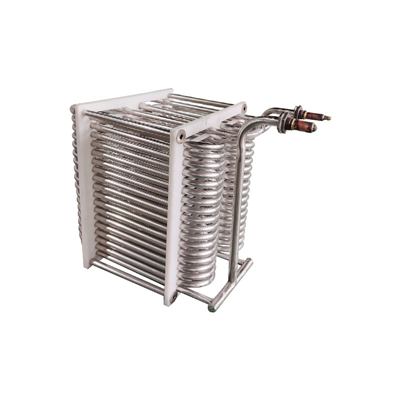
In summary, the surface area of an air – cooled condenser is a critical determinant of its performance. It directly affects the heat transfer rate, condensing capacity, and overall efficiency of the cooling system. By understanding the relationship between surface area, airflow, and other design factors, we can provide our customers with condensers that meet or exceed their performance requirements.
Evaporator If you’re looking for an air – cooled condenser that combines high performance, energy efficiency, and reliability, we’re here to help. Our team of experts can work with you to design and manufacture a customized condenser solution that fits your specific needs. Whether you’re in the commercial, industrial, or power generation sector, we have the experience and expertise to deliver the right product. Reach out to us to start a conversation about your condenser requirements and how we can collaborate to achieve your cooling goals.
References
- Holman, J. P. (1997). Heat Transfer. McGraw – Hill.
- Incropera, F. P., & De Witt, D. P. (2001). Fundamentals of Heat and Mass Transfer. Wiley.
Xiangshui Derkang Refrigeration Equipment Co., Ltd.
Address: No. 2, Xiaojian Town Entrepreneurship Park, Xiangshui County
E-mail: 505745223@qq.com
WebSite: https://www.xsderk.com/
